

What Challenges Is Vietnam’s Mechanical Industry Facing?
Below is an illustrative chart showing the domestic vs. imported market share in Vietnam’s mechanical industry for the period 2025–2026, based on data from reputable sources such as the Vietnam Association of Mechanical Industries (VAMI), the Ministry of Industry and Trade (MoIT), and the latest reports (2024–2025), with stable or minor changes projected into 2026 due to persistently high import dependency.
- 3,100 mechanical manufacturing enterprises, accounting for ~30% of all processing and manufacturing enterprises (Source: VAMI).
- Domestic products hold only ~7–30% of the local market → heavy reliance on imports (raw materials, components).
- Rising raw material costs, excess inventory/waste → reduced competitiveness.
- Many enterprises lose orders due to delayed delivery (pressure from FDI and international markets).
- Green transformation/ESG requirements from 2026: Loss of orders if unable to keep up.
- High localization in the motorcycle sub-sector (85–95%), but precision mechanical machining and component manufacturing (such as molds and CNC machines) remain heavily import-dependent → resulting in lost competitive advantage in the domestic market.
- 2026 forecast: Slight increase in domestic share if supporting industries are strongly promoted, but high import dependency persists due to ESG/CBAM requirements and raw material volatility.
- 2026 trend: Strong pressure to increase localization (driven by FTAs and policies prioritizing Vietnamese goods), yet rapid change remains difficult without robust mechanisms (such as restrictions on imports where domestic production is feasible).
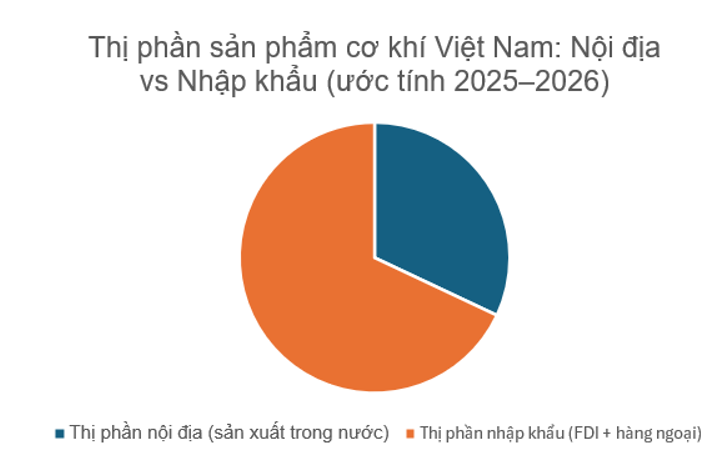
Domestic products hold only 7–30% of the local market → resulting in heavy reliance on imports

Risk: Sudden material shortages during global supply chain disruptions, leading to production halts and loss of FDI contracts.
Specific Solution: VSIC-ERP implements intelligent MRP + real-time low-stock alerts, enabling accurate demand planning and reducing import dependency by prioritizing domestic sources and strategic reserves.
Results: Sudden shortages reduced to under 5%, localization increased by 10–15% within 12 months.
Risk: Exclusion from priority lists for major projects, missing breakthrough growth opportunities.
Specific Solution: VSIC-ERP provides real-time localization tracking dashboards + MRP prioritizing Vietnamese sources → rapid development of import substitution mechanisms, increasing localization by 15–25% and meeting FTA requirements and policies favoring domestic goods.
Rising raw material costs, excess inventory/waste
Risk: Rising unit costs, capital tied up, declining profits, and high bankruptcy risk if prices cannot be reduced.
Specific Solution: VSIC-ERP implements batch-based inventory management + aging stock alerts (>90 days), combined with precise MRP demand calculation → reducing excess inventory by 20–30%, freeing up billions in working capital, lowering storage costs, and minimizing obsolescence risks.

Lost orders due to delayed delivery (pressure from FDI & international markets)

Risk: Loss of long-term FDI contracts, collapse of reputation, and sharp revenue decline.
Specific Solution: VSIC-ERP integrates Sales → MRP → Production → QC for real-time production order progress tracking and early OTD risk alerts → increasing OTD from 75–85% to 95%+ within 6 months, retaining major clients and expanding contracts.
Green Transformation/ESG from 2026: Loss of Orders if Unable to Keep Up
Risk: Order cancellations from the EU, high carbon taxes, and export market share reduction of 20–40%.
Specific Solution: VSIC-ERP integrates a carbon footprint tracking module (incorporating energy consumption and recycled material data) and generates ESG reports compliant with CBAM standards → preparing enterprises to meet green requirements, retaining and expanding orders from European customers.