

Cloud / On-premise / Hybrid
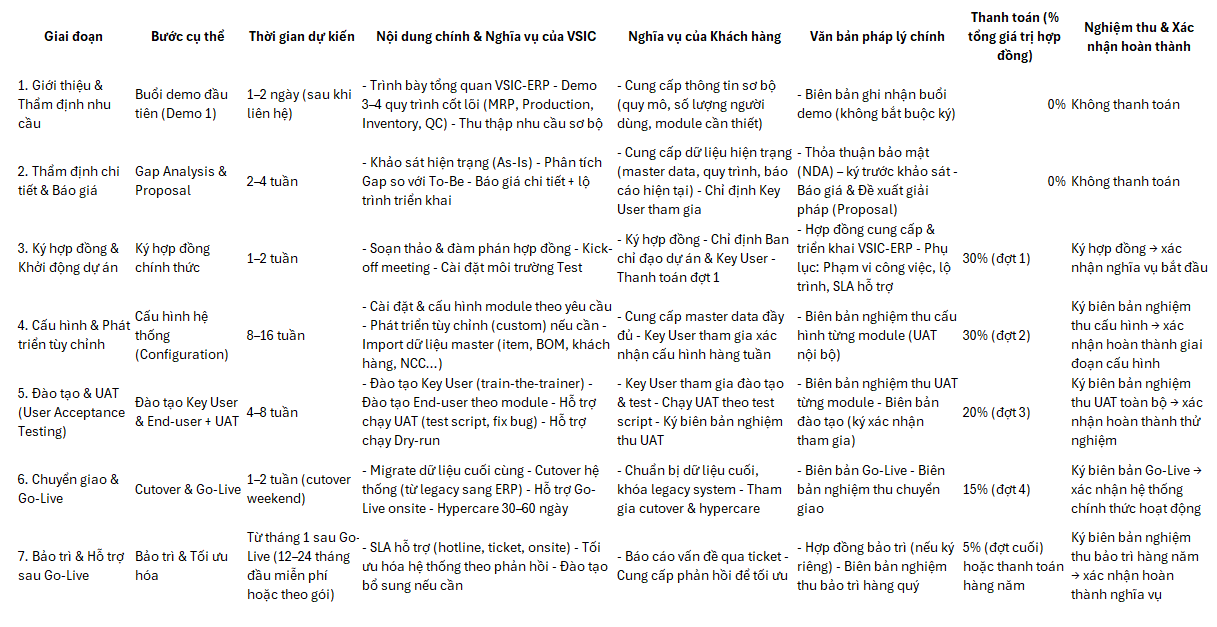
The following is a detailed implementation roadmap for VSIC-ERP software, specially designed for Vietnamese precision mechanical manufacturing and machining enterprises. This roadmap ensures full transparency, strict legal compliance, and milestone-based payments tied to the actual completion of obligations.
Estimated total duration: 6–10 months (depending on enterprise scale: 50–500 employees, 1–3 factories). Payment method: Phased, with payments released only upon completion of obligations and signing of phase acceptance minutes.
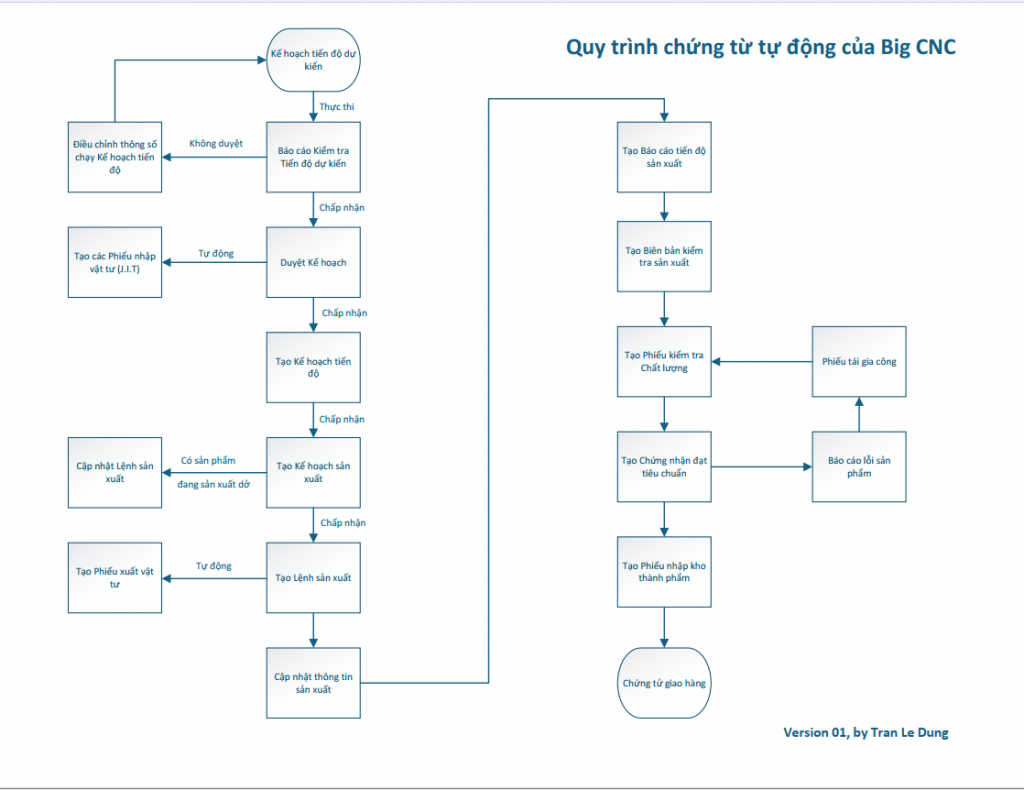
Automated Customer Document Workflow
After conducting on-site surveys of the enterprise’s actual operations through observation, research, interviews, and evaluation, VSIC proposes standardized operating procedures to formally unify the enterprise’s activities within the scope of consultation.
Below is the automated document workflow recommended by VSIC for one enterprise. This workflow enables client enterprises to clearly understand the core operating processes of mechanical manufacturing and machining activities, with particular emphasis on the steps designed in relation to Preliminary Schedule Planning.
KICK-OFF MEETING MINUTES FOR VSIC-ERP IMPLEMENTATION PROJECT

Project Name: Implementation of VSIC ERP System for [Company Name]
Meeting Date/Time: [Date] from [Start Time] to [End Time]
Location: 2nd Floor Meeting Room / Online via Zoom/Teams
Number of Attendees: 18 persons (list attached)
Chairperson: Mr./Ms. [General Director Name] – General Director of the Company
Secretary: Mr./Ms. [Project Manager Name] – Project Manager
1. Meeting Objectives
- Officially launch the VSIC-ERP implementation project.
- Introduce the project objectives, scope, and expected benefits.
- Announce the project organization (Steering Committee & Project Team).
- Secure commitments from leadership and relevant departments.
- Conduct internal communication to ensure company-wide understanding and support for the project.
2. Key Attendees (Main List)
- Leadership: General Director, Production Director, Finance Director, Sales Department Head
- Project Steering Committee: [List of 5–7 persons]
- Project Team: Project Manager, Key Users from departments (Production, Warehouse, QC, Maintenance, Sales)
- VSIC Representative: Mr./Ms. [VSIC Representative Name] – Implementation Team Lead
- Guests: Production Shift Leaders, Representative Team Leaders (employee representatives)
3. Main Meeting Agenda
- Opening Remarks (General Director – 5 minutes)
- Introduction to the rationale for ERP implementation:
- Current state: Fragmented data, delays, recurring errors, low OTD (80–85%).
- Objectives: Achieve OTD ≥95%, reduce excess inventory by 30%, reduce defects by 50%, increase OEE by 15–20%.
- Commitment: This is a company-wide strategic project, not an IT department initiative.
- Call to action: All employees are urged to participate, support, and embrace change without resistance.
- Introduction to the rationale for ERP implementation:
- Project Introduction & Benefits (Project Manager – 10 minutes)
- Project overview: 9-month duration, Go-Live targeted for 01/12/2026..
- Phase 1 scope: MRP, Production, Inventory, QC, Maintenance.
- Specific benefits:
- Real-time inventory → prevent shortages/excess.
- Early delay alerts → increase OTD.
- Real-time production cost tracking → accurate quoting.
- Reduction of manual work → staff focus on production & improvement.
- Risks of non-implementation: Loss of FDI clients, rising costs, declining competitiveness.
- Project Organization Announcement (General Director – 5 minutes)
- Steering Committee: General Director as Head, monthly meetings.
- Project Team: Project Manager + Key Users from each department.
- VSIC Representative: Support for implementation & training.
- Roadmap & Gantt Chart Introduction (Project Manager – 10 minutes)
- Presentation of 9-month timeline (Phase 0 → 3).
- Key milestones:
- 30/04/2026: Scope & hợp đồng phê duyệt.
- 31/07/2026: UAT pass.
- 01/12/2026: Go-Live.
- Progress commitment: Weekly reports, monthly steering committee meetings.
- VSIC Representative Remarks (VSIC Representative – 5 minutes)
- Experience in implementing ERP for the mechanical industry.
- Support commitment: Implementation team, training, SLA for bug fixes.
- Advice: Clean master data early, prioritize process changes over customization.
- Discussion & Q&A (All attendees – 15 minutes)
- Common questions:
- “Will ERP cause job losses?” → No, it reduces manual work.
- “What is the cost?” → Budget has been prepared; details will be presented later.
- “Will staff receive full training?” → Train-the-trainer plan is in place.
- Common questions:
- Closing & Commitment (General Director – 5 minutes)
- Request maximum support from all departments.
- Leadership commitment: The project will succeed through collective participation.
- Meeting adjournment: 10:30.
4. Meeting Conclusion
- All attendees unanimously agreed to launch the project.
- Leadership committed to providing resources and ongoing communication.
- Departments committed to cooperation and full provision of information during the current-state survey.
5. Attached Appendices
- Attendance list (signed).
- Presentation slides (PowerPoint).
- Preliminary project Gantt chart.
- Draft Scope Document.
Minutes Prepared by: [Project Manager Name]
Date: 15/03/2026
Approved by: [General Director Name] General Director
Some Practical Experiences / Real-World Lessons
ERP is the “diagnostician and surgeon” for the enterprise
In healthcare—the field where VSIC has spent over a decade advising major hospital chains—we all understand a vital truth:
If a doctor cannot accurately diagnose a life-threatening condition (silent stage 1 cancer, quietly blocked coronary arteries, chronic infection gnawing away), then even the most expensive prescriptions, complex surgeries, or advanced machinery are futile—or worse, accelerate the patient’s decline.
Similarly, if VSIC-ERP cannot precisely diagnose the critical weaknesses in a precision mechanical manufacturing enterprise, all implementation efforts become meaningless or counterproductive:
- Failure to correctly detect “chronic material shortages” (like severe anemia in the body) → the enterprise continues to experience frequent machine stoppages even though surface inventory appears “sufficient.”
- Failure to correctly detect “production process bottlenecks” (like 90% narrowed coronary arteries) → persistently low OEE despite investments in expensive additional machinery.
- Failure to correctly detect “blocked cash flow” (like congestive heart failure) → prolonged receivables and mounting interest despite superficial revenue growth.
- Failure to correctly detect “latent quality defects” (like early-stage metastatic cancer) → explosion of FDI customer complaints, loss of long-term contracts, and collapse of reputation.

Accurate diagnosis is the life-saving first step. VSIC-ERP begins with an in-depth Gap Analysis — equivalent to a comprehensive blood test panel, CT scan, MRI, and biopsy:
- Collect real-world data from the shop floor, warehouse, planning, purchasing, and quality control (QC) departments.
- Identify critical bottlenecks: percentage of excess inventory, root causes of low OTD, which process stages have poor OEE, and the specific reasons behind inflated production costs.
- Provide a precise “surgical plan”: eliminate redundant processes, restructure workflows, configure the ERP accurately in the right places, and focus training on key areas.